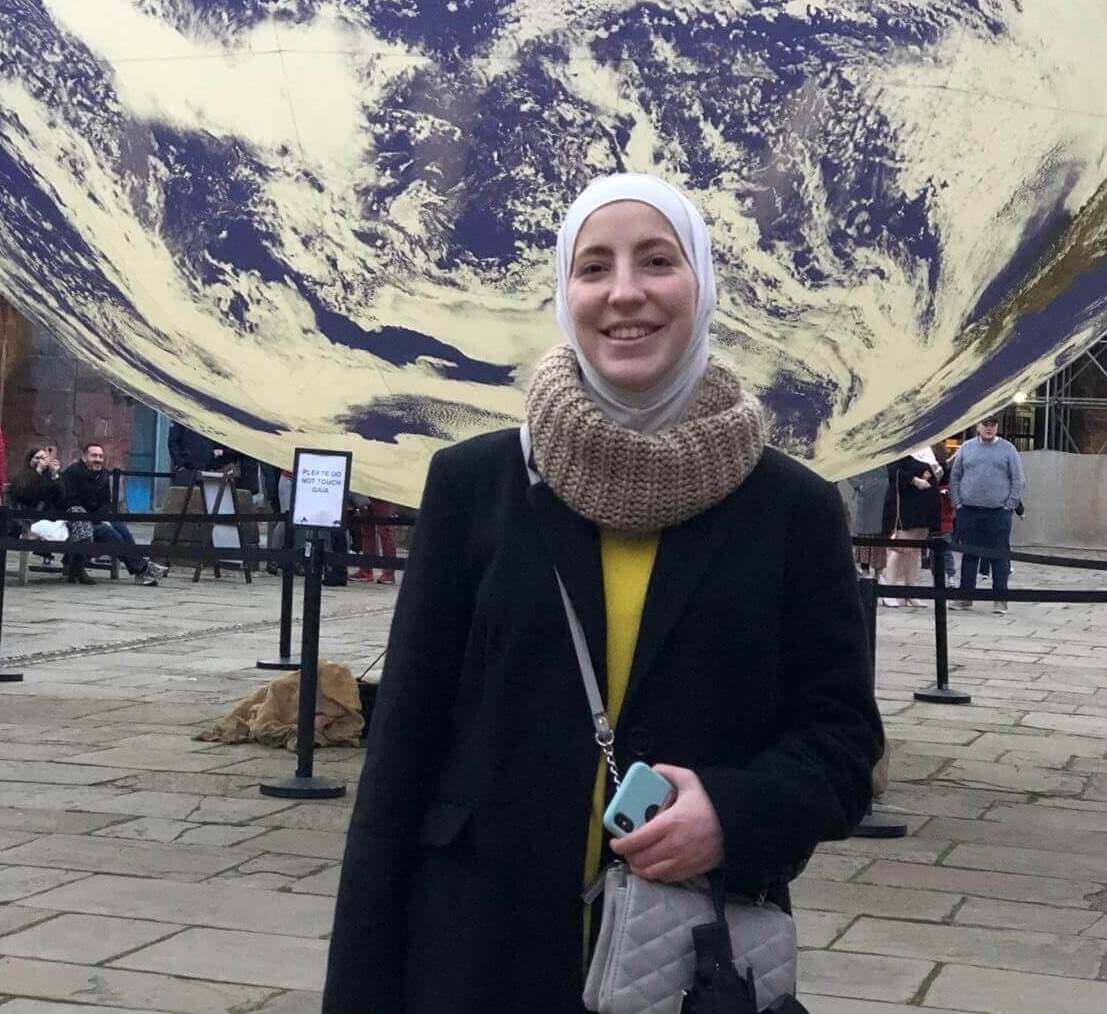
The Science of What We Inherit: A Conversation with Prof. Rana Dajani
March 8, 2026
SCIENTIST SPOTLIGHT
Prof. Rana Dajani is a molecular biologist at the Hashemite University in Jordan, a Harvard Radcliffe Fellow, a Fulbright Scholar, and the founder of We Love Reading, a literacy initiative now active in over 70 countries. Her research spans diabetes genetics, trauma epigenetics, and resilience, with a focus on populations historically underrepresented in global genomic studies.
In 2017, she led the first genome-wide association study specifically investigating Middle Eastern populations, uncovering a diabetes risk locus that had been missed by all previous global research. In February 2025, her study on Syrian refugee families - published in Nature Scientific Reports - reported the first evidence of intergenerational epigenetic signatures of trauma in humans.
This International Women's Day, we spoke with Prof. Dajani about what sparked her curiosity, what her research has revealed, and what excites her about the future of genomics in the region.
The Spark
Your research spans diabetes genetics, trauma epigenetics, and resilience. Was there a specific moment that sparked your interest in studying how our environment shapes our biology?
Growing up, it made sense from an innate place, that we are a product of what we inherit and the environment we interact with. I always had this holistic approach, that things cannot be compartmentalized, that everything is fluid. I wanted to pursue that question and understand the relationship between environment and biology.
As a scientist, you are a product of what the science is at the time, but you're also part of changing the science as you go forward; by asking new questions, analyzing, and deducting to come up with new frameworks for how we understand nature around us.
I wanted to understand experience through biology because biology is more precise. You can measure your genes, your proteins, versus just studying behavior. It gives more objectivity. It helps us understand behavior by removing biases that could come from studying the environment alone.
Maybe what really triggered me is my own experience, being a daughter of a refugee and seeing how the rhetoric is that those whose parents and grandparents went through trauma are considered victims. But I see myself and my colleagues all over the world, how they are steadfast, how they flourish, how they thrive, contrary to that framing.
This drove her to re-evaluate how we understand the impact of environment and trauma on our genes. Not to follow existing frameworks blindly, but to lead and explore.
The Discovery
Your recent study on Syrian refugee families (Nature Scientific Reports, 2025) found the first evidence of intergenerational epigenetic signatures of trauma. What was the most surprising finding for you?
The most surprising discovery was that the 14 epigenetic sites we found, passed on to grandchildren who had not themselves experienced trauma, were not found in any known biological pathway related to any known medical disease.
This was an "aha moment" for Prof. Dajani. The implication: inheriting an epigenetic signature of trauma doesn't necessarily mean you're destined for negative health outcomes.
To me, that made so much sense, looking at who I am, and the generations of people from parents and grandparents who had been through trauma. When we talk about other species, like octopus, we talk about adaptability. But with humans, the rhetoric is 'these are victims.' Now I have the evidence to talk about adaptability in humans.
She calls this her "grandmother's wisdom" the idea that those who inherit the epigenetics of trauma are not simply vulnerable, but possess agency, adaptability, and control over their lives going forward.
Everybody I talked to, especially from the global south, found it fascinating and freeing, a license to live, pursue, thrive, and flourish.
The research shifts the framework from binary thinking - victim or hero - to a spectrum of human response. Some will suffer. Some will thrive. Most will fall somewhere in between. And that diversity, she says, is worth celebrating.
Beyond Resilience: Sumud
You've spoken about studying 'the epigenetics of resilience', not just trauma. Can you share more about this perspective?
Prof. Dajani is cautious about the word "resilience." While it moves beyond victimhood, it can also place a burden, the expectation that everyone must simply survive.
I shy away from this binary, this compartmentalization. Nature is a continuum. How we respond to trauma is a continuum. Some of us will be victims, some will be heroes, but most will be everything in between. This is closer to nature.
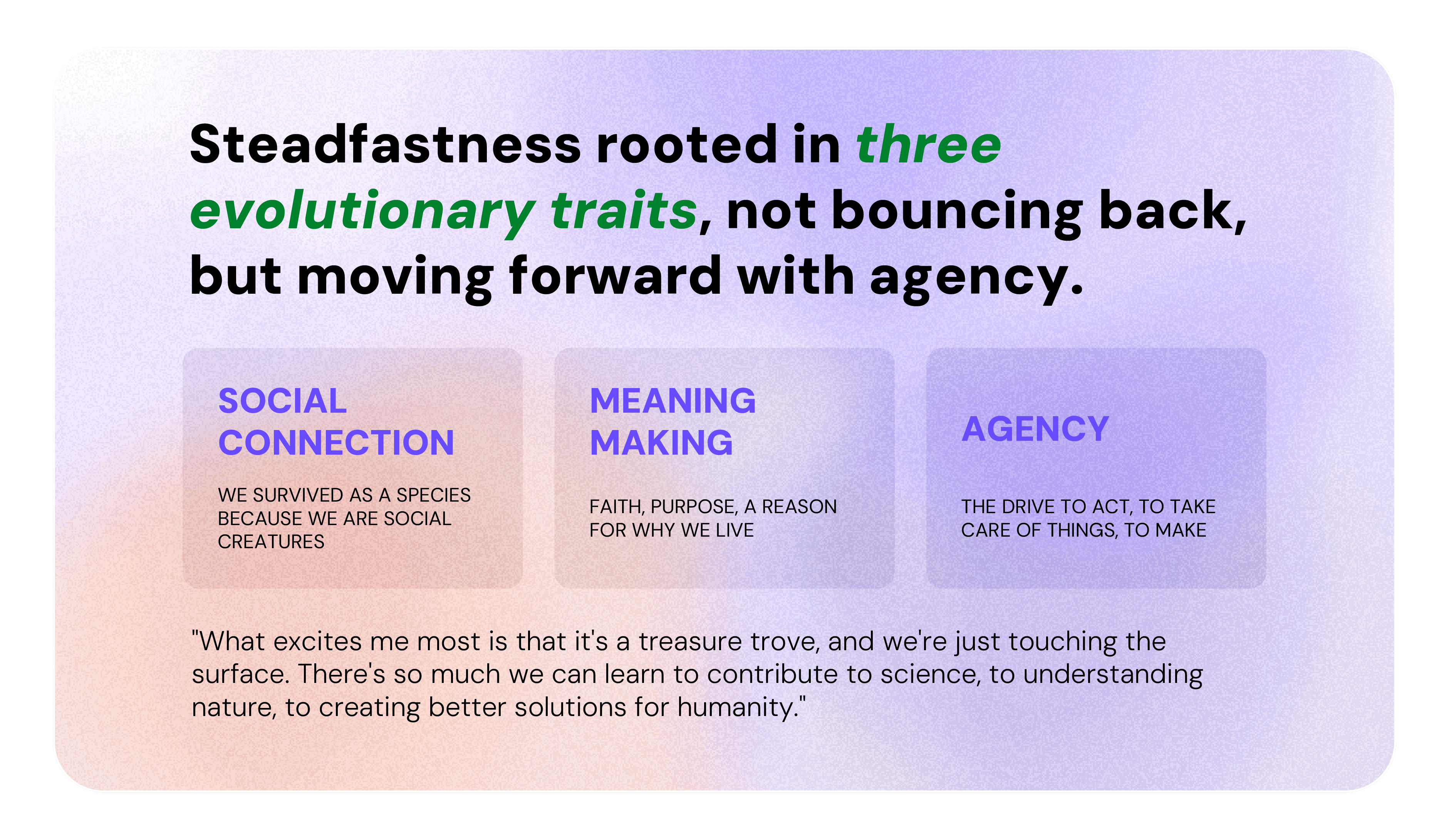
Instead, she's drawn to an Arabic concept “Sumud”, often translated as steadfastness. It's not about bouncing back. It's about moving forward with agency, even under the most difficult circumstances.
She traces Sumud to three traits, all rooted in evolutionary biology:
- Social connection: we survived as a species because we are social creatures.
- Meaning-making: faith, purpose, a reason for why we live.
- Agency: the drive to act, to take care of things, to make decisions.
There's a famous saying: people don't suffer unless there's no meaning. These traits are real phenomena, and that's how we survived as a species.
Her next research question: can we measure Sumud? Can we find its biomarkers, its epigenetics? What does it look like, not from a place of depravity, but from a place of adaptability?
Innovation at the Boundaries
You're a molecular biologist, but also a literacy advocate, an ethics contributor, and a mentor. How do these different roles inform each other?
The different roles I have, they flow into each other. They're not separate. What guides me is my curiosity and the need of the moment, driven by a sense of responsibility that stems from my faith
When she's doing research, she's thinking about ethics. When she's mentoring, she's sharing expertise. When she's frustrated in one discipline, she moves to another, and returns refreshed.
When you come from one discipline into another, you come in fresh and naive. You see things others haven't seen, because they've been in the field too long, too limited by what's 'allowed' and what's 'possible.' Innovation happens at the boundaries of disciplines.
This fluidity between science, ethics, literacy, and community is not a distraction from her work. It is her work.
Comfort with Ambiguity
What's been one of the biggest challenges in conducting genomics research in this region?
Surprisingly, Prof. Dajani doesn’t point to funding or access, she points to something else: mindset.
The biggest challenge is the lack of ability to think outside the box, to reach out, create diverse teams, and communicate across them. People are usually siloed. They shy away from interacting. Sometimes that stems from not being comfortable with ambiguity.
For her, the solution is trust, and a willingness to say "I don't know."
I'm very comfortable with ambiguity. I'm very comfortable saying, 'I don't know.' I'm comfortable reaching out and saying, 'Teach me. I want to learn from you.' It's about building trust.
She also emphasizes scientific communication, not just between researchers, but with communities. Explaining the science so people are on board.
A scientist is somebody who sees what everybody sees, but thinks what no one has thought.
A Treasure Trove
Looking ahead, what excites you most about the future of genomics research in the MENA region?
What excites me most is that it's a treasure trove, and we're just touching the surface. There's so much we can learn to contribute to science, to understanding nature, to creating better solutions for humanity.
Precision medicine. Prevention. Therapeutics. All of it, she believes, is within reach if researchers in the region pursue the questions that matter to their communities.
I am excited to work with everybody around me to do science that serves humanity, which stems from our culture, our duty in this world.
Prof. Rana Dajani's work reminds us that science is not just about discovery; it's about perspective. Who asks the questions matters. And sometimes, the most important breakthroughs come not from new data, but from new ways of seeing.
Related Posts
- Bioinformatics
- nf-core
Democratizing Genomic Research: nf-core and the Power of No-Code, Reproducible Pipelines
This article explores the importance of nf-core pipelines in modern bioinformatics, breaking down how they enable reproducible, standardized, and scalable genomic data analysis. Whether you're working with RNA sequencing, genetic variant detection, or building a bioinformatics workflow, discover how no-code platforms like Bionl are making powerful Nextflow-based pipelines accessible to researchers, clinicians, and scientists of all backgrounds — without needing to write a single line of code.
Jul 2025
Layla Bitar
- Bioinformatics
- Research
The Revolution of Drug Discovery: The Impact of Artificial Intelligence
In the ever-evolving landscape of healthcare, drug discovery remains one of the most critical and complex processes. The development of new drugs is essential for tackling diseases and improving the quality of life. However, traditional drug discovery methods are often time-consuming and costly. This is where Artificial Intelligence (AI) steps in, offering innovative solutions to streamline and enhance drug discovery.
Jun 2023